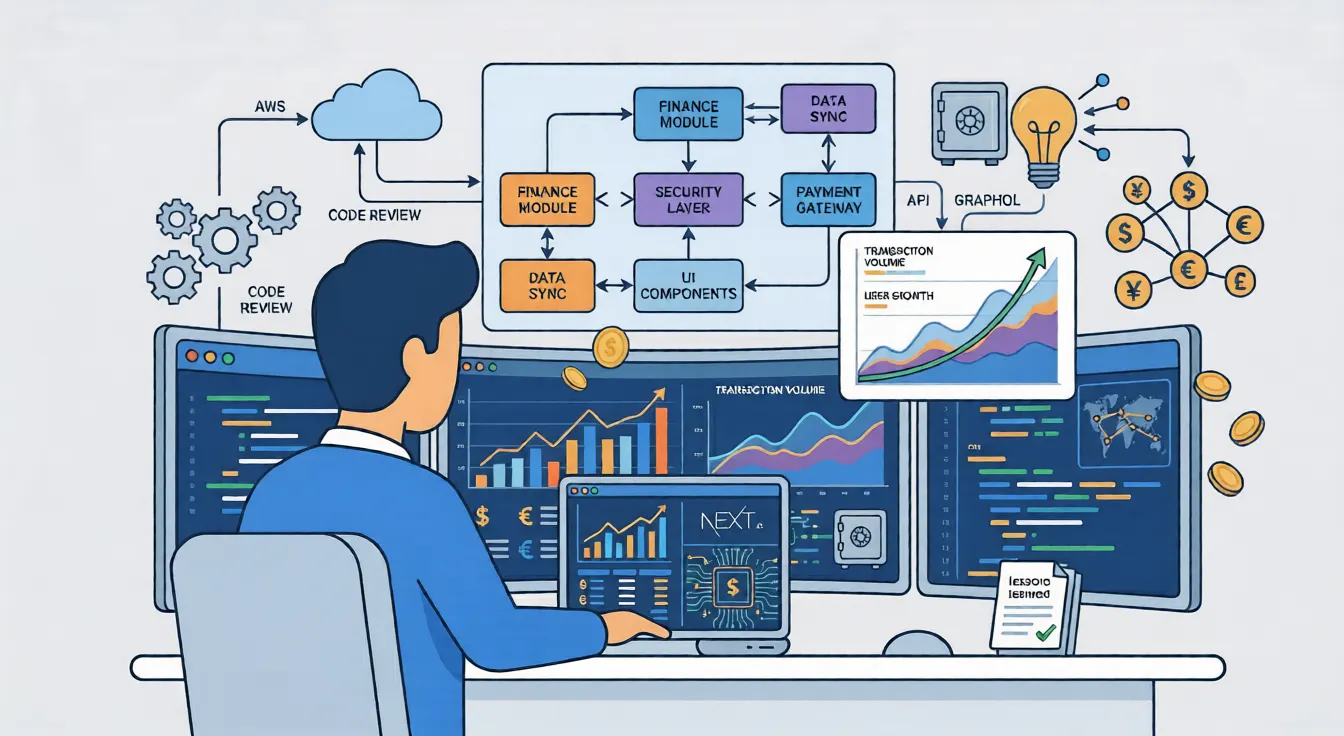
The Problem With Fintech Frontends
Fintech apps don't forgive sloppy architecture. When real money is on the line, the cost of a wrong abstraction is measured in incidents, not just tech debt. Most architecture guides talk about "scalability" in the abstract. This one is about the specific, painful trade-offs that only show up when you're building payment dashboards, trading interfaces, or compliance tools.
This article won't tell you which state manager to use. It will tell you why the wrong mental model for financial state will burn you — and what the right one looks like in practice.
1. Treat Financial State Like a Ledger, Not a Store
The first mistake most developers make is reaching for mutable state to represent financial data. A Redux store asks "what is the current value?" A ledger asks "what is the current value, how did it get here, and can I prove it?" In regulated environments, those are very different questions.
The pattern that works is treating your client store as an append-only event log. Every change is an event. The UI derives state by replaying those events. This maps directly to how backends in fintech already work — and makes audit trails possible on the client side.
// Mutable snapshot — cannot reconstruct history
const [balance, setBalance] = useState(1000);
setBalance(balance - 250); // no record of why

// Event-sourced — every change is traceable
type LedgerEvent =
  | { type: 'CREDIT'; amount: number; ref: string; ts: number }
  | { type: 'DEBIT';  amount: number; ref: string; ts: number };

const balanceFromEvents = (events: LedgerEvent[]) =>
  events.reduce((acc, e) =>
    e.type === 'CREDIT' ? acc + e.amount : acc - e.amount, 0);
You don't need a special library for this. A plain array in Zustand or Redux, appended to on every server event, is enough to unlock replay, debugging, and audit logging on the frontend.
2. Real-Time Data Has an Architecture Problem, Not a Library Problem
Fintech UIs are almost always "live" — balances update, order books tick, compliance flags fire. The mistake is treating real-time as a feature to add later and a library to pick. It's an architecture decision you make upfront.
Here's the decision matrix that actually matters:
- Polling — Use for low-stakes updates (account summaries, report status). Simple, debuggable, no persistent connections to manage.
- Server-Sent Events (SSE) — Use for one-way server pushes: notifications, transaction feeds, order status. Native in Next.js App Router, automatic reconnect, HTTP-native.
- WebSockets — Use only when both client and server need to talk simultaneously: live order books, collaborative compliance review, trading interfaces.
// SSE in Next.js App Router — clean, native, no library needed
// app/api/transactions/stream/route.ts
export async function GET(req: Request) {
  const session = await getServerSession();
  if (!session) return new Response('Unauthorized', { status: 401 });

  const stream = new ReadableStream({
    start(controller) {
      const enc = new TextEncoder();
      const push = (data: object) =>
        controller.enqueue(enc.encode(`data: ${JSON.stringify(data)}\n\n`));

      // Subscribe to your event source (Redis pub/sub, DB trigger, etc.)
      const unsub = subscribeToUserTransactions(session.userId, push);

      req.signal.addEventListener('abort', () => {
        unsub();
        controller.close();
      });
    },
  });

  return new Response(stream, {
    headers: {
      'Content-Type': 'text/event-stream',
      'Cache-Control': 'no-cache',
      'Connection': 'keep-alive',
    },
  });
}
The hidden cost of WebSockets in fintech is not implementation — it's operations. Horizontal scaling requires a pub/sub layer (Redis is standard). Connection management, reconnection logic, and authenticated handshakes all need explicit handling. SSE handles most fintech use cases at a fraction of that operational cost.
3. Security Boundaries Live in the Component Tree
Fintech apps have a characteristic that most web apps don't: different parts of the same screen can have different permission levels. A dashboard might show a user their own balance (low risk) and a compliance officer the full audit trail (high sensitivity) — sometimes in adjacent panels.
The mistake is encoding permissions as a single boolean flag in a top-level context. The architecture that scales is treating permission as a component boundary, not a runtime check.
// Permission as runtime check — easy to miss, hard to audit
function TransactionRow({ tx }: { tx: Transaction }) {
  const { role } = useAuth();
  return (

      {tx.amount}
      {role === 'compliance' && {tx.internalRef}}

  );
}

// Permission as component boundary — explicit, testable
function ComplianceTransactionRow({ tx }: { tx: Transaction }) {
  return (

      {tx.amount}
      {tx.internalRef}

  );
}

// Route-level guard enforces access — component has no auth logic
This matters for more than security — it matters for testing. A component with conditional auth logic requires you to mock the auth state in every test. A component that renders unconditionally, guarded at the route level, tests cleanly with no auth mocking at all.
4. Monorepos Are Not Optional at Scale
Fintech products grow into product suites: customer portal, internal ops dashboard, compliance tool, mobile app. The teams that try to keep these as separate repositories spend enormous energy managing shared types, design system drift, and conflicting API contracts.
A monorepo doesn't mean one giant app. It means shared boundaries are explicit and versioned — shared types, shared UI primitives, shared API clients all live in packages that apps consume.
/repo
  /apps
    /customer-portal     ← Next.js app
    /ops-dashboard       ← Next.js app
    /compliance-tool     ← Next.js app
  /packages
    /ui                  ← shared component library
    /api-client          ← typed API layer (generated from OpenAPI)
    /domain-types        ← Transaction, Account, User — source of truth
    /auth                ← shared auth utilities and guards
  turbo.json
  pnpm-workspace.yaml
The key insight is that It /packages/domain-types is the contract between the frontend and the backend. When the backend changes a field, the TypeScript compiler surfaces every frontend breakage immediately — across all apps simultaneously. No drift, no "we forgot to update the portal."
5. Error States Are a Product Feature, Not an Afterthought
In fintech, a payment failing silently is worse than a payment failing loudly. Users need to know exactly what happened, what they can do, and whether they need to contact support. A generic "Something went wrong" message is a compliance and trust problem, not just a UX problem.
The architecture change models errors as typed domain states, not exceptions.
type PaymentState =
  | { status: 'idle' }
  | { status: 'pending'; transactionId: string }
  | { status: 'success'; transactionId: string; settlesAt: Date }
  | { status: 'declined'; reason: 'insufficient_funds' | 'card_expired' | 'fraud_hold' }
  | { status: 'error'; retryable: boolean; supportRef: string };

function PaymentStatus({ state }: { state: PaymentState }) {
  if (state.status === 'declined' && state.reason === 'fraud_hold') {
    return ;  // specific, actionable UI
  }
  if (state.status === 'error' && state.retryable) {
    return ;
  }
  // ... other states
}
When error states are types, the compiler tells you when you've forgotten to handle a case. When they're caught exceptions, you find out in production — from a user who tried to pay for something.
Final Thoughts
Scalable fintech frontend architecture is not about choosing the right libraries. It's about making the right decisions invisible — the kind where a new developer can look at the codebase and immediately understand the rules. Ledger-style state, explicit permission boundaries, real-time transport matched to use case, monorepo contracts, typed error states: these aren't clever tricks. They're the foundations that keep a $5M project from becoming a $500K rewrite.
Ship with intention. The architecture you choose on day one is the one you'll defend at your next incident review.